Discourse and representation of gender are communicated in different ways throughout every culture. We use discourse to shape our ideologies through many different regimes of truth (Donovan, Spring 2013). Japan is known to have a distinct perspective on fashion. Fashion serves as an insightful cultural lens which can be used to draw conclusions about a culture's perspective on gender. This post explores how different facets of fashion media shape the discourse regarding gender and representation in Japan.
Bihaku

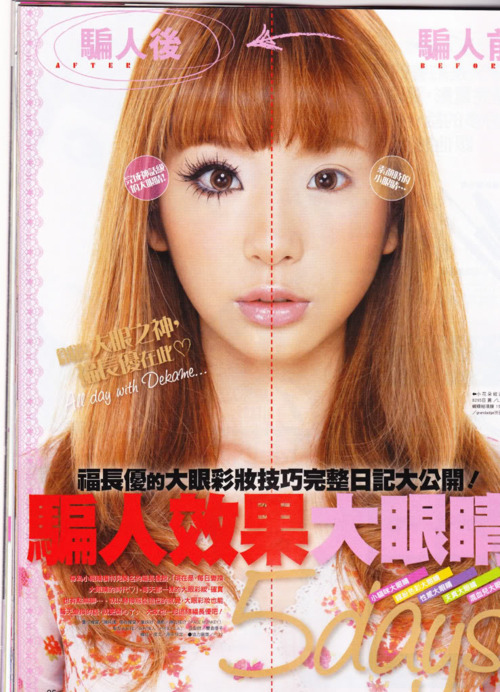
Japanese culture has long held the cultural preference toward lighter skin tones. Historically, the preference has originated from the idea that women with darker complexions were likely laborers of lower classes who worked in the sun. Since the 1980s, the introduction of 'whitening' products by the cosmetics industry has created a boom in emphasis of this trait. Women use these products seeking to express higher social status, youth, beauty and desirability which are perpetuated by the media's portrayal of Japanese beauty.
Bihaku Advertisement
Gyaru
 |
| Source |


Source Source


Mass media exposure to trends usually triggers the rejection of the style after a period to make way for a new invention, but Gyaru was co-opted by non-urban working-class youth, who used it to defy traditional Japanese standards of beauty.


Though the look may appear to be an attempt to emulate western standards of beauty, featuring tan skin and blonde hair, the ganguro fashion movement is actually an act of defiance against traditional forms of Japanese beauty. In the past, youth fashion trends catch on and flame out within a span of 5-10 years, but gyaru continues to evolve and serves as commentary on the culture's awareness of the influence media has on public perception of beauty.
Link: History of the Gyaru
Yaeba

The New York Times recently reported on a cosmetic trend in Japan, where women seek to have dental implants that enhance imperfections in their teeth. Depending on one's perspective, this trend may seem cute and embracing more natural forms of beauty, but is also seen as another way females are infantilized to please a paternalistic society.
Further Reading
Todd Joseph Miles Holden is a social scientist who has studied the influence Japanese fashion media has on gender and identity. His work on the subject can be found below.
"Through a large array of intentional communication strategies, fashion
magazines (whether male or female) reduce gender classes (but women, in
particular) to types capable of fitting into or bridging cohorts. Fashion is not a
static entity. It exists not only on pages of magazines, but also out in the
world: on the streets, in offices, shop windows, on public transportation. It is
a living topic that is shaped and influenced by so many factors beyond words
and images in commercial media. This serves as a caveat mitigating
wholesale acceptance of the conclusions presented on these pages. In
Japan, there are few media more robust and communication-full than
fashion magazines. They are rich texts brimming with an assortment of
profound, extremely complicated social content." -Holden

No comments:
Post a Comment